
Author: Torino Social Impact
On 29 January 2026, social economy organisations from across Europe gathered online for the fourth Transnational Workshop of the DO Impact Capacity Building Programme. This time, the focus was exploring how digitalisation and data use can strengthen organisations’ capacity to measure and understand social impact.
The webinar was attended by around 69 participants from 19 countries, confirming strong transnational engagement across Europe and neighbouring regions.
Among inspiring keynote speeches, case studies, and interactive discussions, it quickly became clear that talking about data and social impact can be interesting and fundamental for the digitalisation process. Participants learned about concrete methodologies, digital tools, and data-driven approaches, turning theoretical concepts into practical examples they can apply in their own organisations.
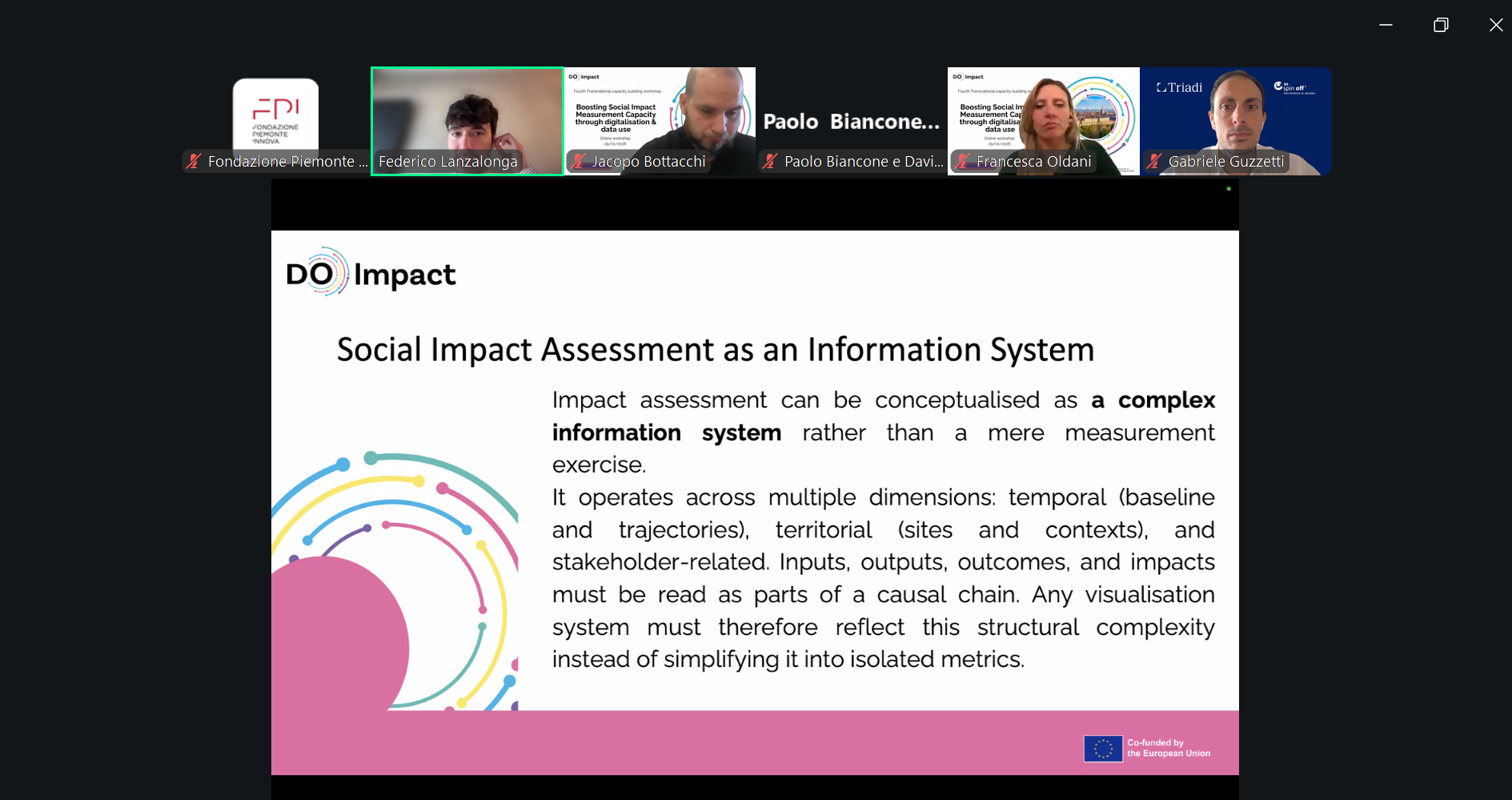
The morning started with a keynote by Professor Mario Calderini, spokesperson of Torino Social Impact and professor at Politecnico di Milano, who invited participants to rethink social impact assessment not as a simple measurement exercise, but as a complex information system. Impact, he argued, unfolds across time, territories, and stakeholders, and data should be read as part of a causal chain linking inputs, outputs, and long-term outcomes.
One important recurring theme of his speech was the growing importance of data assurance and shared data infrastructures, such as data lakes, alongside the challenges they bring. Questions quickly emerged: how granular should impact data be? Who should act as the custodian of sector-level data? And how can standards and infrastructures be built for something as intangible as social impact? In Turin’s ecosystem, this role has historically been linked to the Chamber of Commerce – but when impact enters the picture, governance becomes more complex.
The conversation then moved from theory to practice. Cottino Social Impact Campus dedicated the first part of its session to an overview of impact measurement methodologies, focusing on frameworks, models, and — most importantly — real-world challenges. From underlining the importance of intentionality and additionality, to dealing with incomplete or imperfect data, one message stood out clearly: there is no single way to measure impact. Measurement choices must always reflect context, purpose, and organisational capacity.
And then came a reminder worth repeating: impact measurement is not just about numbers: it’s about meaning, responsibility, and the ability to translate social change into something that can guide decisions.
The University of Turin took participants one step further. After a brief introduction to the University Professional Development Course in Social Impact Assessment, , the session turned fully practical. Over 45 minutes, participants explored methodologies and digital tools for measuring and visualising impact, including real examples of dashboards and data visualisation systems.
The discussion also touched on generative AI, to be seen not as a magic solution, but as a helpful and evolving tool to be used thoughtfully. While AI is still more effective for data scraping and processing than for true impact interpretation, its potential for enabling mass customisation of impact measurement sparked a lively debate. Could AI help balance the trade-off between cost-effective, standardised approaches and deeper, tailor-made evaluations? The jury is still out, but the conversation has clearly begun.
Finally, Gabriele Guzzetti from Triadi, Politecnico di Milano, led an interactive and highly practical session, translating theory into concrete applications. Starting from real use cases, the session explored how social economy organisations typically progress along a gradual path of digitalisation for impact measurement.
Guzzetti showed how a large number of organisations still rely on basic digital tools for data collection, management, and visualisation. These tools are accessible and flexible, but when they are not embedded in a coherent system, they often lead to fragmented datasets. From there, the discussion moved towards more structured impact and ESG platforms already in use across Europe.
Throughout the workshop, one powerful idea kept resurfacing: for social enterprises, data can be as valuable as money. Strong data systems make intervention models clearer, organisations more resilient, and social businesses more investment-ready. In short, data strengthens both impact and sustainability.
Key takeaways:
- Impact measurement is not a checklist, it’s an information system that evolves over time and across contexts.
- There is no “one-size-fits-all” methodology — intentionality, measurability, and additionality matter more than rigid models.
- Data governance is still an open issue: who owns impact data, and who is responsible for maintaining it, remain key challenges.
- AI has potential, but ethics comes right after. Social impact measurement needs moral clarity before technical shortcuts.
- Good data makes social enterprises stronger, by improving decision-making, credibility, and long-term sustainability.
What’s next?
From 3 to 5 March 2026, the DO Impact journey continues in Barcelona with the workshop “Advancing Digital Transformation in the Social Economy through Data Use & Applied AI”. Three days dedicated to data, visualisation, applied AI and digital transformation for social economy enabling organisations.